Location
Location ANSS
The ANSS event ID is nn00913580 and the event page is at
https://earthquake.usgs.gov/earthquakes/eventpage/nn00913580/executive.
2026/03/31 16:01:57 41.172 -116.703 10.0 3.9 Nevada
Focal Mechanism
 USGS/SLU Moment Tensor Solution
 ENS  2026/03/31 16:01:57.0  41.17 -116.70  10.0 3.9 Nevada

 Stations used:
   BK.BIGV BK.EAGL BK.MNLT BK.MZTA BK.RAVE BK.SWNM BK.YUBA
   IE.BCYI IM.NV31 IW.MFID IW.PLID LB.BMN LB.TPH NC.AFD NN.BEK
   NN.BFC NN.DIX NN.GMN NN.KVN NN.LHV NN.MPK NN.OUT1 NN.PAH
   NN.PIO NN.PRN NN.PYM2 NN.Q09A NN.R11B NN.WAK NN.WASH NN.YER
   UO.ADEL UO.JAZZ UO.PRONG UO.RANT UO.SLPT UO.WAGON US.BMO
   US.DUG US.ELK US.HLID US.HWUT US.WVOR UU.BEID UU.BGU UU.CTU
   UU.FOR1 UU.FSU UU.HDUT UU.HVU UU.MCU UU.NLU UU.NOQ UU.SPU
   UU.TCU UW.BURN UW.IRON UW.IZEE UW.TREE WW.CNCL WW.CTNW
   WW.IRMR

 Filtering commands used:
   cut o DIST/3.3 -40 o DIST/3.3 +50
   rtr
   taper w 0.1
   hp c 0.03 n 3
   lp c 0.10 n 3

 Best Fitting Double Couple
  Mo = 5.50e+21 dyne-cm
  Mw = 3.76
  Z  = 13 km
  Plane   Strike  Dip  Rake
   NP1      234    71   -126
   NP2      120    40   -30
  Principal Axes:
   Axis    Value   Plunge  Azimuth
    T   5.50e+21     18     350
    N   0.00e+00     34     247
    P  -5.50e+21     50     103

 Moment Tensor: (dyne-cm)
    Component   Value
       Mxx     4.68e+21
       Mxy    -3.58e+20
       Mxz     2.24e+21
       Myy    -1.97e+21
       Myz    -2.92e+21
       Mzz    -2.71e+21


                     ##   #########
                 ###### T #############
              #########   ################
             ##############################
           ################################--
          ##########################----------
         -######################---------------
        --###################-------------------
        --################----------------------
       ----#############-------------------------
       ----##########----------------------------
       -----#######-----------------   ----------
       ------#####------------------ P ----------
        -------#--------------------   ---------
        ------##--------------------------------
         ----#####-----------------------------
          --#########-------------------------
           #############-------------------##
             ##################-------#####
              ############################
                 ######################
                     ##############


 Global CMT Convention Moment Tensor:
      R          T          P
 -2.71e+21   2.24e+21   2.92e+21
  2.24e+21   4.68e+21   3.58e+20
  2.92e+21   3.58e+20  -1.97e+21


Details of the solution is found at

http://www.eas.slu.edu/eqc/eqc_mt/MECH.NA/20260331160157/index.html
|
Preferred Solution
The preferred solution from an analysis of the surface-wave spectral amplitude radiation pattern, waveform inversion or first motion observations is
      STK = 120
      DIP = 40
     RAKE = -30
       MW = 3.76
       HS = 13.0
The NDK file is 20260331160157.ndk
The waveform inversion is preferred.
Moment Tensor Comparison
The following compares this source inversion to those provided by others. The purpose is to look for major differences and also to note slight differences that might be inherent to the processing procedure. For completeness the USGS/SLU solution is repeated from above.
| SLU |
UNR |
 USGS/SLU Moment Tensor Solution
 ENS  2026/03/31 16:01:57.0  41.17 -116.70  10.0 3.9 Nevada

 Stations used:
   BK.BIGV BK.EAGL BK.MNLT BK.MZTA BK.RAVE BK.SWNM BK.YUBA
   IE.BCYI IM.NV31 IW.MFID IW.PLID LB.BMN LB.TPH NC.AFD NN.BEK
   NN.BFC NN.DIX NN.GMN NN.KVN NN.LHV NN.MPK NN.OUT1 NN.PAH
   NN.PIO NN.PRN NN.PYM2 NN.Q09A NN.R11B NN.WAK NN.WASH NN.YER
   UO.ADEL UO.JAZZ UO.PRONG UO.RANT UO.SLPT UO.WAGON US.BMO
   US.DUG US.ELK US.HLID US.HWUT US.WVOR UU.BEID UU.BGU UU.CTU
   UU.FOR1 UU.FSU UU.HDUT UU.HVU UU.MCU UU.NLU UU.NOQ UU.SPU
   UU.TCU UW.BURN UW.IRON UW.IZEE UW.TREE WW.CNCL WW.CTNW
   WW.IRMR

 Filtering commands used:
   cut o DIST/3.3 -40 o DIST/3.3 +50
   rtr
   taper w 0.1
   hp c 0.03 n 3
   lp c 0.10 n 3

 Best Fitting Double Couple
  Mo = 5.50e+21 dyne-cm
  Mw = 3.76
  Z  = 13 km
  Plane   Strike  Dip  Rake
   NP1      234    71   -126
   NP2      120    40   -30
  Principal Axes:
   Axis    Value   Plunge  Azimuth
    T   5.50e+21     18     350
    N   0.00e+00     34     247
    P  -5.50e+21     50     103

 Moment Tensor: (dyne-cm)
    Component   Value
       Mxx     4.68e+21
       Mxy    -3.58e+20
       Mxz     2.24e+21
       Myy    -1.97e+21
       Myz    -2.92e+21
       Mzz    -2.71e+21


                     ##   #########
                 ###### T #############
              #########   ################
             ##############################
           ################################--
          ##########################----------
         -######################---------------
        --###################-------------------
        --################----------------------
       ----#############-------------------------
       ----##########----------------------------
       -----#######-----------------   ----------
       ------#####------------------ P ----------
        -------#--------------------   ---------
        ------##--------------------------------
         ----#####-----------------------------
          --#########-------------------------
           #############-------------------##
             ##################-------#####
              ############################
                 ######################
                     ##############


 Global CMT Convention Moment Tensor:
      R          T          P
 -2.71e+21   2.24e+21   2.92e+21
  2.24e+21   4.68e+21   3.58e+20
  2.92e+21   3.58e+20  -1.97e+21


Details of the solution is found at

http://www.eas.slu.edu/eqc/eqc_mt/MECH.NA/20260331160157/index.html
|
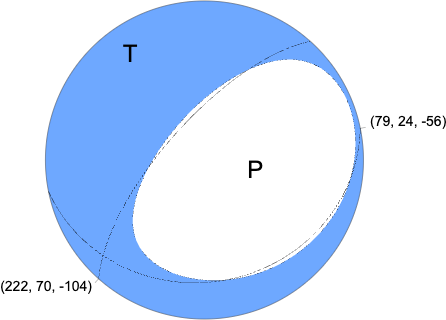
Regional Moment Tensor (Mwr)
Moment 4.807e+14 N-m
Magnitude 3.72 Mwr
Depth 4.0 km
Percent DC 71%
Half Duration -
Catalog NN
Data Source US
Contributor US

Nodal Planes
Plane	Strike	Dip	Rake
NP1	222	70	-104
NP2	79	24	-56
Principal Axes
Axis	Value	Plunge	Azimuth
T	4.385e+14	24	323
N	0.755e+14	13	227
P	-5.140e+14	62	110
|
Magnitudes
Given the availability of digital waveforms for determination of the moment tensor, this section documents the added processing leading to mLg, if appropriate to the region, and ML by application of the respective IASPEI formulae. As a research study, the linear distance term of the IASPEI formula
for ML is adjusted to remove a linear distance trend in residuals to give a regionally defined ML. The defined ML uses horizontal component recordings, but the same procedure is applied to the vertical components since there may be some interest in vertical component ground motions. Residual plots versus distance may indicate interesting features of ground motion scaling in some distance ranges. A residual plot of the regionalized magnitude is given as a function of distance and azimuth, since data sets may transcend different wave propagation provinces.
ML Magnitude
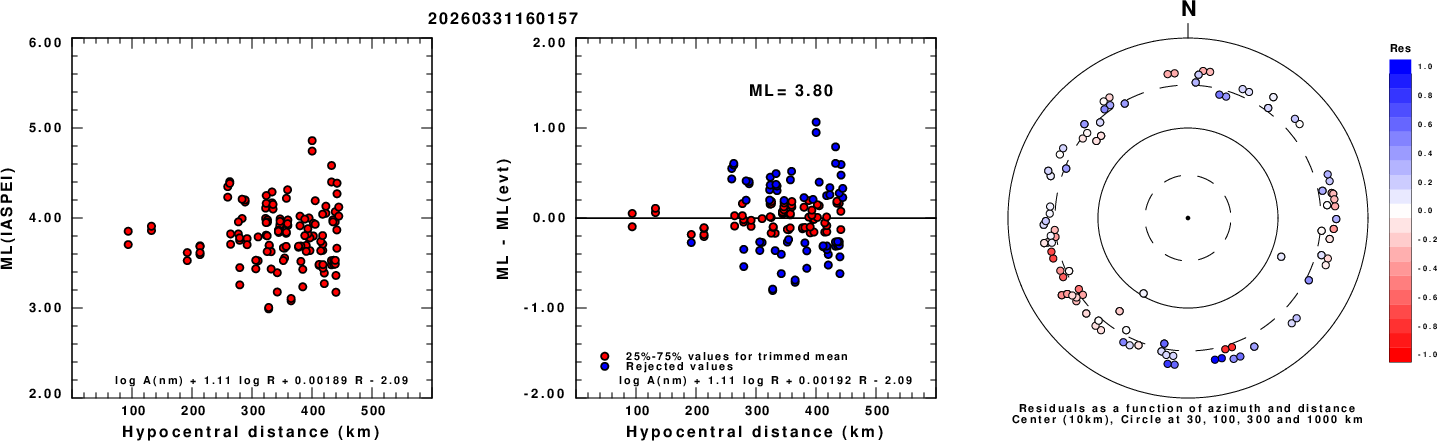
Left: ML computed using the IASPEI formula for Horizontal components. Center: ML residuals computed using a modified IASPEI formula that accounts for path specific attenuation; the values used for the trimmed mean are indicated. The ML relation used for each figure is given at the bottom of each plot.
Right: Residuals from new relation as a function of distance and azimuth.
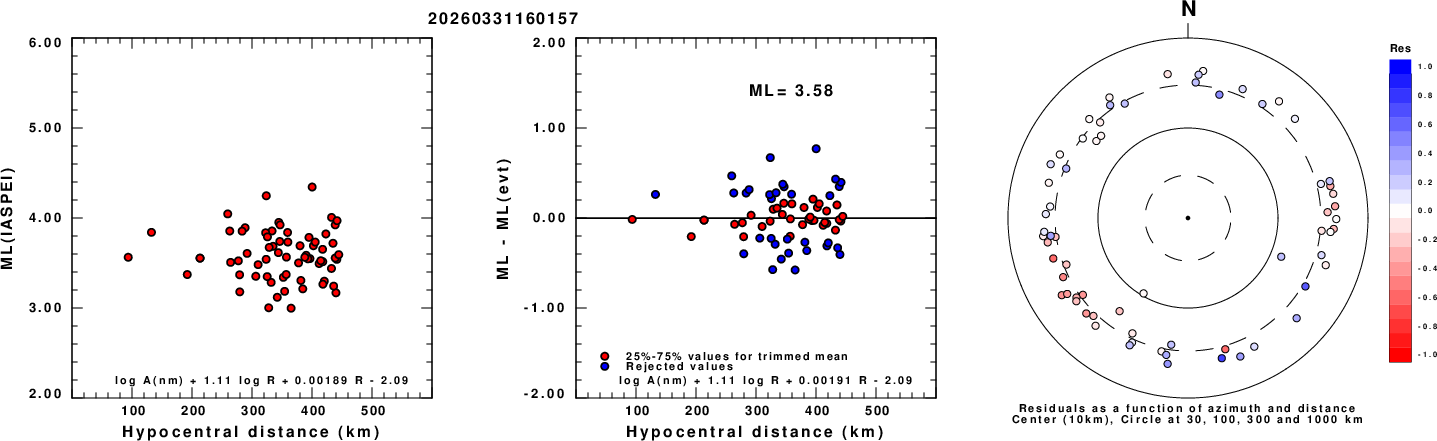
Left: ML computed using the IASPEI formula for Vertical components (research). Center: ML residuals computed using a modified IASPEI formula that accounts for path specific attenuation; the values used for the trimmed mean are indicated. The ML relation used for each figure is given at the bottom of each plot.
Right: Residuals from new relation as a function of distance and azimuth.
Context
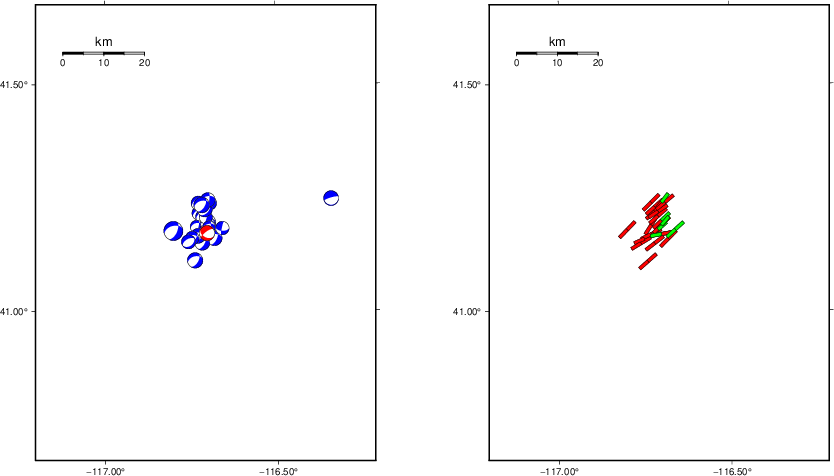
The left panel of the next figure presents the focal mechanism for this earthquake (red) in the context of other nearby events (blue) in the SLU Moment Tensor Catalog. The right panel shows the inferred direction of maximum compressive stress and the type of faulting (green is strike-slip, red is normal, blue is thrust; oblique is shown by a combination of colors). Thus context plot is useful for assessing the appropriateness of the moment tensor of this event.
Waveform Inversion using wvfgrd96
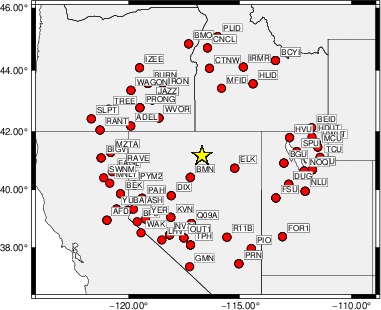
The focal mechanism was determined using broadband seismic waveforms. The location of the event (star) and the
stations used for (red) the waveform inversion are shown in the next figure.
|
|
Location of broadband stations used for waveform inversion
|
The program wvfgrd96 was used with good traces observed at short distance to determine the focal mechanism, depth and seismic moment. This technique requires a high quality signal and well determined velocity model for the Green's functions. To the extent that these are the quality data, this type of mechanism should be preferred over the radiation pattern technique which requires the separate step of defining the pressure and tension quadrants and the correct strike.
The observed and predicted traces are filtered using the following gsac commands:
cut o DIST/3.3 -40 o DIST/3.3 +50
rtr
taper w 0.1
hp c 0.03 n 3
lp c 0.10 n 3
The results of this grid search are as follow:
           DEPTH  STK   DIP  RAKE   MW    FIT
WVFGRD96    1.0   340    70    25   3.40 0.3535
WVFGRD96    2.0   340    60    30   3.51 0.3874
WVFGRD96    3.0   335    45    20   3.56 0.3761
WVFGRD96    4.0   330    35    15   3.58 0.4092
WVFGRD96    5.0   130    25   -15   3.59 0.4538
WVFGRD96    6.0   130    30   -15   3.60 0.4948
WVFGRD96    7.0   130    35   -20   3.61 0.5255
WVFGRD96    8.0   125    30   -25   3.69 0.5493
WVFGRD96    9.0   125    35   -25   3.70 0.5728
WVFGRD96   10.0   120    35   -30   3.72 0.5913
WVFGRD96   11.0   120    35   -30   3.73 0.6018
WVFGRD96   12.0   120    40   -30   3.74 0.6072
WVFGRD96   13.0   120    40   -30   3.76 0.6072
WVFGRD96   14.0   120    40   -30   3.77 0.6018
WVFGRD96   15.0   120    40   -25   3.78 0.5930
WVFGRD96   16.0   120    40   -25   3.79 0.5810
WVFGRD96   17.0   120    40   -25   3.80 0.5666
WVFGRD96   18.0   120    40   -25   3.81 0.5496
WVFGRD96   19.0   120    40   -25   3.82 0.5308
WVFGRD96   20.0   120    40   -25   3.83 0.5103
WVFGRD96   21.0   120    40   -25   3.84 0.4891
WVFGRD96   22.0   120    40   -25   3.85 0.4666
WVFGRD96   23.0   120    40   -20   3.85 0.4435
WVFGRD96   24.0   120    35   -20   3.86 0.4213
WVFGRD96   25.0   120    35   -20   3.86 0.3991
WVFGRD96   26.0   120    35   -20   3.87 0.3773
WVFGRD96   27.0   120    35   -20   3.87 0.3564
WVFGRD96   28.0   115    35   -25   3.87 0.3361
WVFGRD96   29.0   115    35   -25   3.87 0.3167
The best solution is
WVFGRD96 13.0 120 40 -30 3.76 0.6072
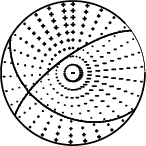
The mechanism corresponding to the best fit is
|
|
Figure 1. Waveform inversion focal mechanism
|
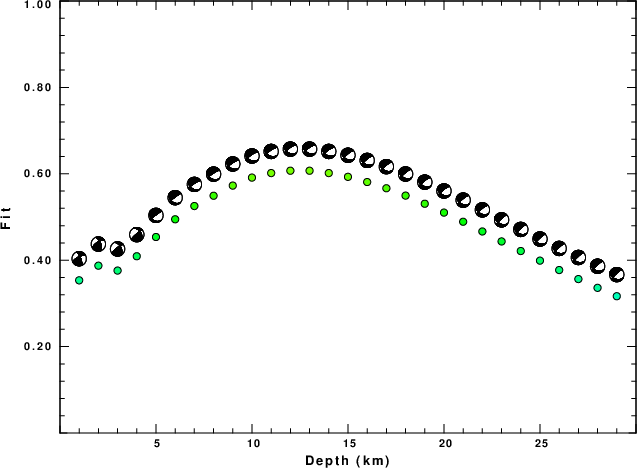
The best fit as a function of depth is given in the following figure:
|
|
Figure 2. Depth sensitivity for waveform mechanism
|
The comparison of the observed and predicted waveforms is given in the next figure. The red traces are the observed and the blue are the predicted.
Each observed-predicted component is plotted to the same scale and peak amplitudes are indicated by the numbers to the left of each trace. A pair of numbers is given in black at the right of each predicted traces. The upper number it the time shift required for maximum correlation between the observed and predicted traces. This time shift is required because the synthetics are not computed at exactly the same distance as the observed, the velocity model used in the predictions may not be perfect and the epicentral parameters may be be off.
A positive time shift indicates that the prediction is too fast and should be delayed to match the observed trace (shift to the right in this figure). A negative value indicates that the prediction is too slow. The lower number gives the percentage of variance reduction to characterize the individual goodness of fit (100% indicates a perfect fit).
The bandpass filter used in the processing and for the display was
cut o DIST/3.3 -40 o DIST/3.3 +50
rtr
taper w 0.1
hp c 0.03 n 3
lp c 0.10 n 3

|
|
Figure 3. Waveform comparison for selected depth. Red: observed; Blue - predicted. The time shift with respect to the model prediction is indicated. The percent of fit is also indicated. The time scale is relative to the first trace sample.
|
|
|
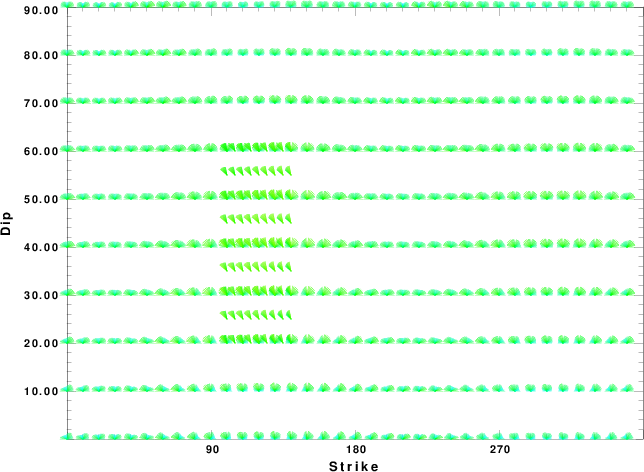
Focal mechanism sensitivity at the preferred depth. The red color indicates a very good fit to the waveforms.
Each solution is plotted as a vector at a given value of strike and dip with the angle of the vector representing the rake angle, measured, with respect to the upward vertical (N) in the figure.
|
A check on the assumed source location is possible by looking at the time shifts between the observed and predicted traces. The time shifts for waveform matching arise for several reasons:
- The origin time and epicentral distance are incorrect
- The velocity model used for the inversion is incorrect
- The velocity model used to define the P-arrival time is not the
same as the velocity model used for the waveform inversion
(assuming that the initial trace alignment is based on the
P arrival time)
Assuming only a mislocation, the time shifts are fit to a functional form:
Time_shift = A + B cos Azimuth + C Sin Azimuth
The time shifts for this inversion lead to the next figure:
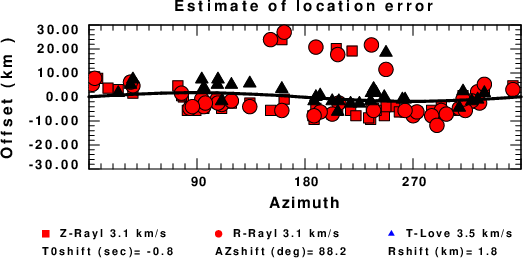
The derived shift in origin time and epicentral coordinates are given at the bottom of the figure.
Velocity Model
The WUS.model used for the waveform synthetic seismograms and for the surface wave eigenfunctions and dispersion is as follows
(The format is in the model96 format of Computer Programs in Seismology).
MODEL.01
Model after     8 iterations
ISOTROPIC
KGS
FLAT EARTH
1-D
CONSTANT VELOCITY
LINE08
LINE09
LINE10
LINE11
      H(KM)   VP(KM/S)   VS(KM/S) RHO(GM/CC)         QP         QS       ETAP       ETAS      FREFP      FREFS
     1.9000     3.4065     2.0089     2.2150  0.302E-02  0.679E-02   0.00       0.00       1.00       1.00
     6.1000     5.5445     3.2953     2.6089  0.349E-02  0.784E-02   0.00       0.00       1.00       1.00
    13.0000     6.2708     3.7396     2.7812  0.212E-02  0.476E-02   0.00       0.00       1.00       1.00
    19.0000     6.4075     3.7680     2.8223  0.111E-02  0.249E-02   0.00       0.00       1.00       1.00
     0.0000     7.9000     4.6200     3.2760  0.164E-10  0.370E-10   0.00       0.00       1.00       1.00
Last Changed Tue Mar 31 12:37:25 CDT 2026