Location
Location ANSS
The ANSS event ID is aka2026gioyfa and the event page is at
https://earthquake.usgs.gov/earthquakes/eventpage/aka2026gioyfa/executive.
2026/03/31 15:44:28 59.765 -152.359 81.4 4.1 Alaska
Focal Mechanism
 USGS/SLU Moment Tensor Solution
 ENS  2026/03/31 15:44:28.0  59.76 -152.36  81.4 4.1 Alaska

 Stations used:
   AK.BRLK AK.CAPN AK.FIRE AK.GHO AK.N18K AK.O18K AK.O19K
   AK.RC01 AK.SKN AK.SLK AK.SSN AT.PMR AV.ACH AV.RED AV.SPCL
   AV.STLK

 Filtering commands used:
   cut o DIST/3.5 -40 o DIST/3.5 +50
   rtr
   taper w 0.1
   hp c 0.03 n 3
   lp c 0.07 n 3
   br c 0.12 0.25 n 4 p 2

 Best Fitting Double Couple
  Mo = 1.78e+22 dyne-cm
  Mw = 4.10
  Z  = 98 km
  Plane   Strike  Dip  Rake
   NP1      310    76   159
   NP2       45    70    15
  Principal Axes:
   Axis    Value   Plunge  Azimuth
    T   1.78e+22     24     266
    N   0.00e+00     65      97
    P  -1.78e+22      4     358

 Moment Tensor: (dyne-cm)
    Component   Value
       Mxx    -1.76e+22
       Mxy     1.48e+21
       Mxz    -1.66e+21
       Myy     1.47e+22
       Myz    -6.65e+21
       Mzz     2.96e+21


                     ----- P ------
                 ---------   ----------
              ----------------------------
             ------------------------------
           #####--------------------------###
          ##########---------------------#####
         ##############------------------######
        #################---------------########
        ####################----------##########
       #######################-------############
       ####   ##################----#############
       #### T ###################################
       ####   ##################----#############
        #######################-------##########
        #####################-----------########
         #################---------------######
          ##############------------------####
           ##########----------------------##
             ###---------------------------
              ----------------------------
                 ----------------------
                     --------------


 Global CMT Convention Moment Tensor:
      R          T          P
  2.96e+21  -1.66e+21   6.65e+21
 -1.66e+21  -1.76e+22  -1.48e+21
  6.65e+21  -1.48e+21   1.47e+22


Details of the solution is found at

http://www.eas.slu.edu/eqc/eqc_mt/MECH.NA/20260331154428/index.html
|
Preferred Solution
The preferred solution from an analysis of the surface-wave spectral amplitude radiation pattern, waveform inversion or first motion observations is
      STK = 45
      DIP = 70
     RAKE = 15
       MW = 4.10
       HS = 98.0
The NDK file is 20260331154428.ndk
The waveform inversion is preferred.
Magnitudes
Given the availability of digital waveforms for determination of the moment tensor, this section documents the added processing leading to mLg, if appropriate to the region, and ML by application of the respective IASPEI formulae. As a research study, the linear distance term of the IASPEI formula
for ML is adjusted to remove a linear distance trend in residuals to give a regionally defined ML. The defined ML uses horizontal component recordings, but the same procedure is applied to the vertical components since there may be some interest in vertical component ground motions. Residual plots versus distance may indicate interesting features of ground motion scaling in some distance ranges. A residual plot of the regionalized magnitude is given as a function of distance and azimuth, since data sets may transcend different wave propagation provinces.
ML Magnitude
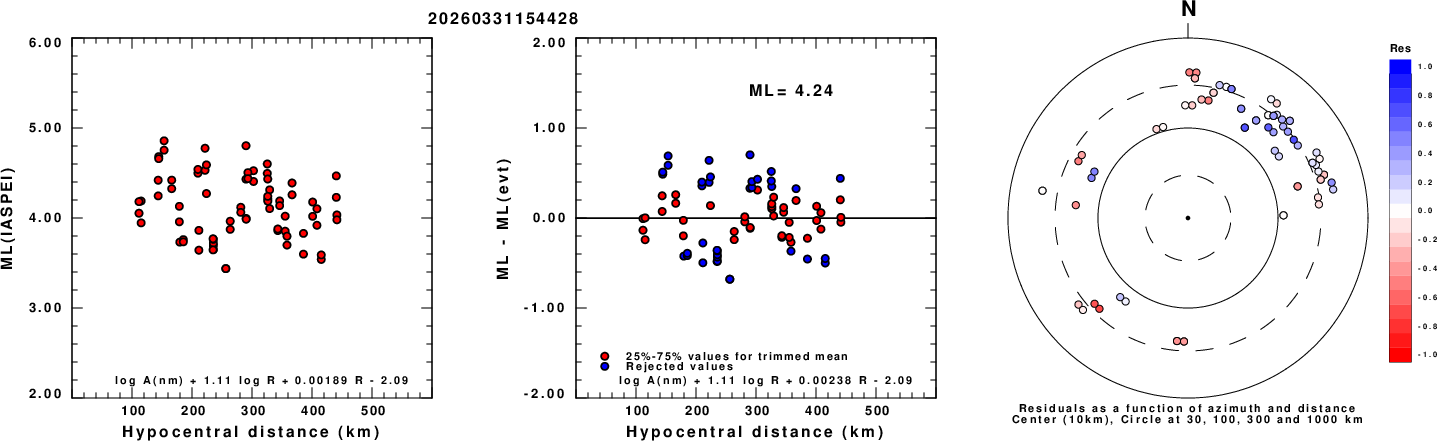
Left: ML computed using the IASPEI formula for Horizontal components. Center: ML residuals computed using a modified IASPEI formula that accounts for path specific attenuation; the values used for the trimmed mean are indicated. The ML relation used for each figure is given at the bottom of each plot.
Right: Residuals from new relation as a function of distance and azimuth.
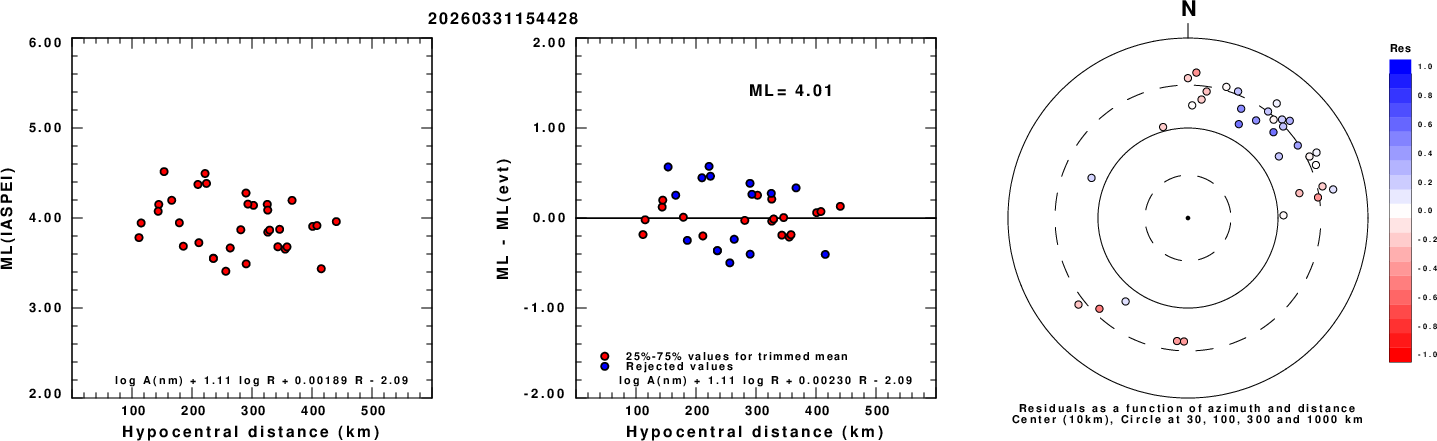
Left: ML computed using the IASPEI formula for Vertical components (research). Center: ML residuals computed using a modified IASPEI formula that accounts for path specific attenuation; the values used for the trimmed mean are indicated. The ML relation used for each figure is given at the bottom of each plot.
Right: Residuals from new relation as a function of distance and azimuth.
Context
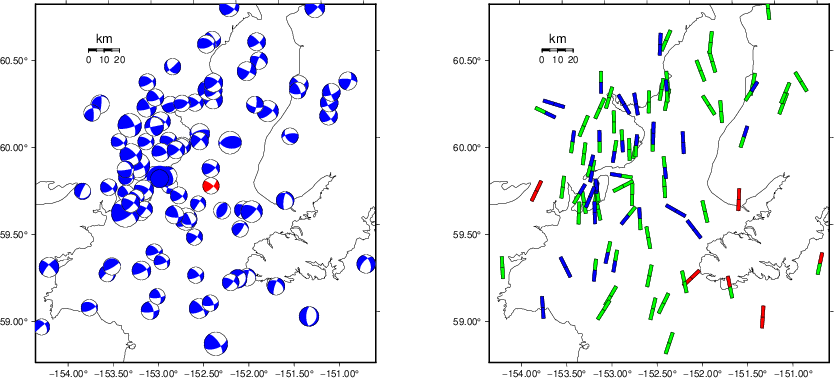
The left panel of the next figure presents the focal mechanism for this earthquake (red) in the context of other nearby events (blue) in the SLU Moment Tensor Catalog. The right panel shows the inferred direction of maximum compressive stress and the type of faulting (green is strike-slip, red is normal, blue is thrust; oblique is shown by a combination of colors). Thus context plot is useful for assessing the appropriateness of the moment tensor of this event.
Waveform Inversion using wvfgrd96
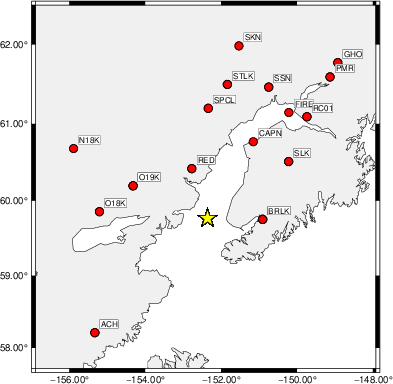
The focal mechanism was determined using broadband seismic waveforms. The location of the event (star) and the
stations used for (red) the waveform inversion are shown in the next figure.
|
|
Location of broadband stations used for waveform inversion
|
The program wvfgrd96 was used with good traces observed at short distance to determine the focal mechanism, depth and seismic moment. This technique requires a high quality signal and well determined velocity model for the Green's functions. To the extent that these are the quality data, this type of mechanism should be preferred over the radiation pattern technique which requires the separate step of defining the pressure and tension quadrants and the correct strike.
The observed and predicted traces are filtered using the following gsac commands:
cut o DIST/3.5 -40 o DIST/3.5 +50
rtr
taper w 0.1
hp c 0.03 n 3
lp c 0.07 n 3
br c 0.12 0.25 n 4 p 2
The results of this grid search are as follow:
           DEPTH  STK   DIP  RAKE   MW    FIT
WVFGRD96    2.0   215    85     0   3.31 0.3668
WVFGRD96    4.0   215    80    -5   3.38 0.4097
WVFGRD96    6.0    40    75     0   3.44 0.4272
WVFGRD96    8.0    40    75     5   3.48 0.4445
WVFGRD96   10.0    40    80     0   3.51 0.4514
WVFGRD96   12.0    40    80     0   3.53 0.4504
WVFGRD96   14.0    35    80   -10   3.54 0.4464
WVFGRD96   16.0   215    90    10   3.56 0.4392
WVFGRD96   18.0    35    80   -10   3.58 0.4338
WVFGRD96   20.0    35    80   -15   3.60 0.4291
WVFGRD96   22.0    35    80   -15   3.62 0.4230
WVFGRD96   24.0    35    80   -15   3.63 0.4162
WVFGRD96   26.0    35    80   -15   3.65 0.4078
WVFGRD96   28.0    35    80   -20   3.67 0.4023
WVFGRD96   30.0    35    80   -20   3.69 0.3981
WVFGRD96   32.0    35    80   -20   3.71 0.3950
WVFGRD96   34.0    35    85   -20   3.73 0.3939
WVFGRD96   36.0    35    85   -20   3.75 0.3954
WVFGRD96   38.0   220    90    15   3.79 0.3956
WVFGRD96   40.0    35    80   -25   3.85 0.4106
WVFGRD96   42.0    35    80   -20   3.86 0.4164
WVFGRD96   44.0    35    80   -20   3.88 0.4206
WVFGRD96   46.0    35    80   -15   3.90 0.4254
WVFGRD96   48.0    35    80   -15   3.91 0.4302
WVFGRD96   50.0    35    80   -15   3.93 0.4356
WVFGRD96   52.0    40    80   -10   3.95 0.4430
WVFGRD96   54.0    40    80   -10   3.97 0.4525
WVFGRD96   56.0    40    80   -10   3.98 0.4616
WVFGRD96   58.0    40    80   -10   3.99 0.4712
WVFGRD96   60.0    40    75     0   4.00 0.4811
WVFGRD96   62.0    40    70     0   4.01 0.4938
WVFGRD96   64.0    40    70     0   4.02 0.5065
WVFGRD96   66.0    40    70     0   4.03 0.5182
WVFGRD96   68.0    40    70     0   4.04 0.5285
WVFGRD96   70.0    40    70     5   4.04 0.5389
WVFGRD96   72.0    40    70     5   4.05 0.5485
WVFGRD96   74.0    40    70     5   4.05 0.5565
WVFGRD96   76.0    40    75    10   4.05 0.5651
WVFGRD96   78.0    40    75    10   4.06 0.5713
WVFGRD96   80.0    40    75    10   4.06 0.5781
WVFGRD96   82.0    45    70    10   4.08 0.5833
WVFGRD96   84.0    45    70    10   4.09 0.5877
WVFGRD96   86.0    45    70    10   4.09 0.5918
WVFGRD96   88.0    45    70    10   4.09 0.5952
WVFGRD96   90.0    45    70    10   4.10 0.5972
WVFGRD96   92.0    45    70    15   4.09 0.5989
WVFGRD96   94.0    45    70    15   4.10 0.6010
WVFGRD96   96.0    45    70    15   4.10 0.6021
WVFGRD96   98.0    45    70    15   4.10 0.6026
WVFGRD96  100.0    45    70    15   4.10 0.6025
WVFGRD96  102.0    45    70    15   4.11 0.6025
WVFGRD96  104.0    45    70    15   4.11 0.6018
WVFGRD96  106.0    45    70    15   4.11 0.6016
WVFGRD96  108.0    45    70    15   4.11 0.6008
WVFGRD96  110.0    45    70    15   4.11 0.5995
WVFGRD96  112.0    45    70    15   4.11 0.5984
WVFGRD96  114.0    45    70    15   4.12 0.5970
WVFGRD96  116.0    45    70    15   4.12 0.5953
WVFGRD96  118.0    45    70    15   4.12 0.5941
WVFGRD96  120.0    45    70    15   4.12 0.5922
WVFGRD96  122.0    45    70    15   4.12 0.5902
WVFGRD96  124.0    45    70    15   4.12 0.5886
WVFGRD96  126.0    45    70    15   4.12 0.5870
WVFGRD96  128.0    40    75    15   4.11 0.5854
The best solution is
WVFGRD96 98.0 45 70 15 4.10 0.6026
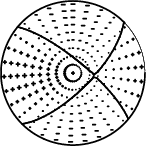
The mechanism corresponding to the best fit is
|
|
Figure 1. Waveform inversion focal mechanism
|
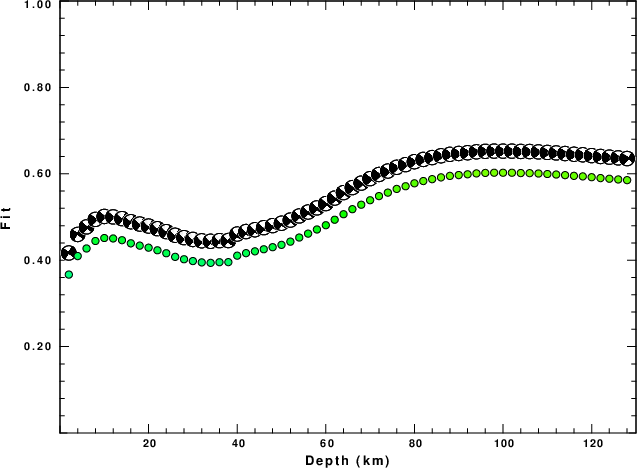
The best fit as a function of depth is given in the following figure:
|
|
Figure 2. Depth sensitivity for waveform mechanism
|
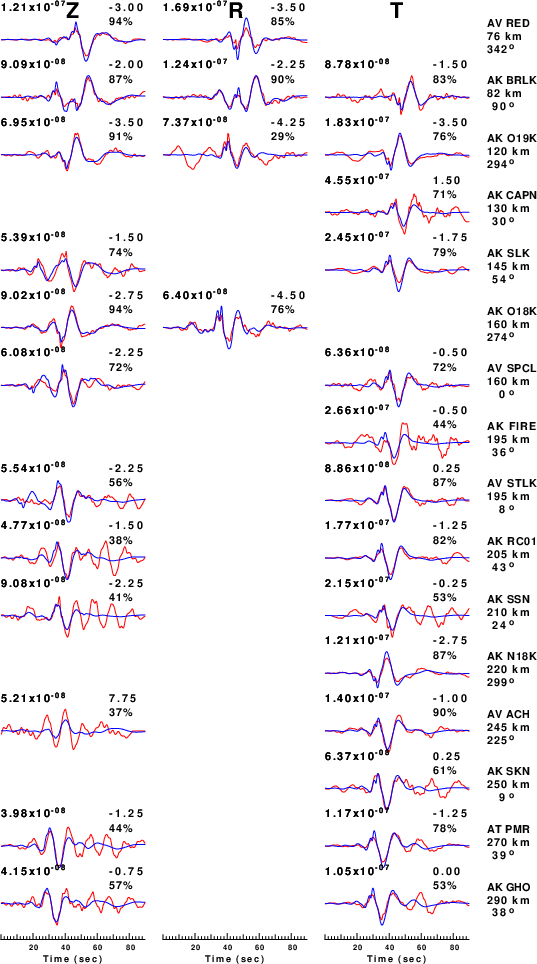
The comparison of the observed and predicted waveforms is given in the next figure. The red traces are the observed and the blue are the predicted.
Each observed-predicted component is plotted to the same scale and peak amplitudes are indicated by the numbers to the left of each trace. A pair of numbers is given in black at the right of each predicted traces. The upper number it the time shift required for maximum correlation between the observed and predicted traces. This time shift is required because the synthetics are not computed at exactly the same distance as the observed, the velocity model used in the predictions may not be perfect and the epicentral parameters may be be off.
A positive time shift indicates that the prediction is too fast and should be delayed to match the observed trace (shift to the right in this figure). A negative value indicates that the prediction is too slow. The lower number gives the percentage of variance reduction to characterize the individual goodness of fit (100% indicates a perfect fit).
The bandpass filter used in the processing and for the display was
cut o DIST/3.5 -40 o DIST/3.5 +50
rtr
taper w 0.1
hp c 0.03 n 3
lp c 0.07 n 3
br c 0.12 0.25 n 4 p 2
|
|
Figure 3. Waveform comparison for selected depth. Red: observed; Blue - predicted. The time shift with respect to the model prediction is indicated. The percent of fit is also indicated. The time scale is relative to the first trace sample.
|
|
|
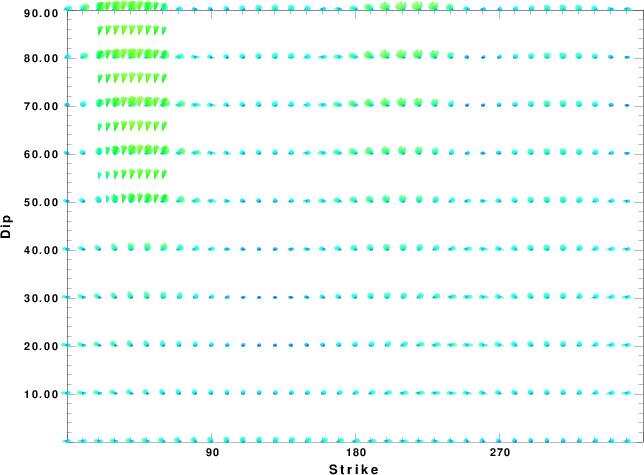
Focal mechanism sensitivity at the preferred depth. The red color indicates a very good fit to the waveforms.
Each solution is plotted as a vector at a given value of strike and dip with the angle of the vector representing the rake angle, measured, with respect to the upward vertical (N) in the figure.
|
A check on the assumed source location is possible by looking at the time shifts between the observed and predicted traces. The time shifts for waveform matching arise for several reasons:
- The origin time and epicentral distance are incorrect
- The velocity model used for the inversion is incorrect
- The velocity model used to define the P-arrival time is not the
same as the velocity model used for the waveform inversion
(assuming that the initial trace alignment is based on the
P arrival time)
Assuming only a mislocation, the time shifts are fit to a functional form:
Time_shift = A + B cos Azimuth + C Sin Azimuth
The time shifts for this inversion lead to the next figure:
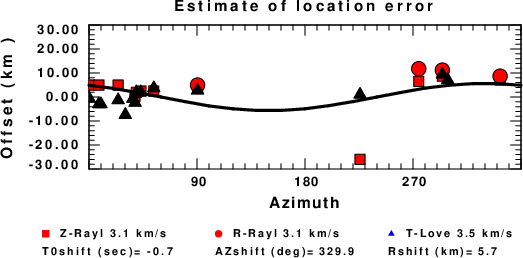
The derived shift in origin time and epicentral coordinates are given at the bottom of the figure.
Velocity Model
The WUS.model used for the waveform synthetic seismograms and for the surface wave eigenfunctions and dispersion is as follows
(The format is in the model96 format of Computer Programs in Seismology).
MODEL.01
Model after     8 iterations
ISOTROPIC
KGS
FLAT EARTH
1-D
CONSTANT VELOCITY
LINE08
LINE09
LINE10
LINE11
      H(KM)   VP(KM/S)   VS(KM/S) RHO(GM/CC)         QP         QS       ETAP       ETAS      FREFP      FREFS
     1.9000     3.4065     2.0089     2.2150  0.302E-02  0.679E-02   0.00       0.00       1.00       1.00
     6.1000     5.5445     3.2953     2.6089  0.349E-02  0.784E-02   0.00       0.00       1.00       1.00
    13.0000     6.2708     3.7396     2.7812  0.212E-02  0.476E-02   0.00       0.00       1.00       1.00
    19.0000     6.4075     3.7680     2.8223  0.111E-02  0.249E-02   0.00       0.00       1.00       1.00
     0.0000     7.9000     4.6200     3.2760  0.164E-10  0.370E-10   0.00       0.00       1.00       1.00
Last Changed Tue Mar 31 11:53:58 CDT 2026