2009/04/06 20:03:34 42.213 13.479 6.6 3.10 Italy
USGS Felt map for this earthquake
 USGS/SLU Moment Tensor Solution
 ENS  2009/04/06 20:03:34:0  42.21   13.48   6.6 3.1 Italy

 Stations used:
   IV.ASSB IV.CERT IV.FAGN IV.FDMO IV.GUAR IV.INTR IV.MNS
   IV.MODR IV.OFFI IV.PTRJ IV.RMP IV.RNI2 IV.SACS IV.TERO
   IV.TOLF MN.AQU

 Filtering commands used:
   hp c 0.02 n 3
   lp c 0.10 n 3

 Best Fitting Double Couple
  Mo = 1.12e+21 dyne-cm
  Mw = 3.30
  Z  = 7 km
  Plane   Strike  Dip  Rake
   NP1      135    60   -109
   NP2      350    35   -60
  Principal Axes:
   Axis    Value   Plunge  Azimuth
    T   1.12e+21     13     239
    N   0.00e+00     17     145
    P  -1.12e+21     69       5

 Moment Tensor: (dyne-cm)
    Component   Value
       Mxx     1.38e+20
       Mxy     4.59e+20
       Mxz    -5.10e+20
       Myy     7.76e+20
       Myz    -2.47e+20
       Mzz    -9.13e+20


                     -------#######
                 ---------------#######
              --------------------########
             -----------------------#######
           ##------------------------########
          ####-------------------------#######
         #####-------------------------########
        #######------------   ----------########
        #######------------ P -----------#######
       #########-----------   -----------########
       ###########------------------------#######
       ############-----------------------#######
       #############----------------------#######
        ##############--------------------######
        ################-----------------#######
         ##   ############---------------######
          # T ###############-----------######
              ##################-------######
             #######################--#####
              #######################-----
                 ##################----
                     ############--


 Global CMT Convention Moment Tensor:
      R          T          P
 -9.13e+20  -5.10e+20   2.47e+20
 -5.10e+20   1.38e+20  -4.59e+20
  2.47e+20  -4.59e+20   7.76e+20


Details of the solution is found at

http://www.eas.slu.edu/eqc/eqc_mt/MECH.IT/20090406200334/index.html
|
      STK = 350
      DIP = 35
     RAKE = -60
       MW = 3.30
       HS = 7.0
The waveform inversion is preferred.
The following compares this source inversion to others
 USGS/SLU Moment Tensor Solution
 ENS  2009/04/06 20:03:34:0  42.21   13.48   6.6 3.1 Italy

 Stations used:
   IV.ASSB IV.CERT IV.FAGN IV.FDMO IV.GUAR IV.INTR IV.MNS
   IV.MODR IV.OFFI IV.PTRJ IV.RMP IV.RNI2 IV.SACS IV.TERO
   IV.TOLF MN.AQU

 Filtering commands used:
   hp c 0.02 n 3
   lp c 0.10 n 3

 Best Fitting Double Couple
  Mo = 1.12e+21 dyne-cm
  Mw = 3.30
  Z  = 7 km
  Plane   Strike  Dip  Rake
   NP1      135    60   -109
   NP2      350    35   -60
  Principal Axes:
   Axis    Value   Plunge  Azimuth
    T   1.12e+21     13     239
    N   0.00e+00     17     145
    P  -1.12e+21     69       5

 Moment Tensor: (dyne-cm)
    Component   Value
       Mxx     1.38e+20
       Mxy     4.59e+20
       Mxz    -5.10e+20
       Myy     7.76e+20
       Myz    -2.47e+20
       Mzz    -9.13e+20


                     -------#######
                 ---------------#######
              --------------------########
             -----------------------#######
           ##------------------------########
          ####-------------------------#######
         #####-------------------------########
        #######------------   ----------########
        #######------------ P -----------#######
       #########-----------   -----------########
       ###########------------------------#######
       ############-----------------------#######
       #############----------------------#######
        ##############--------------------######
        ################-----------------#######
         ##   ############---------------######
          # T ###############-----------######
              ##################-------######
             #######################--#####
              #######################-----
                 ##################----
                     ############--


 Global CMT Convention Moment Tensor:
      R          T          P
 -9.13e+20  -5.10e+20   2.47e+20
 -5.10e+20   1.38e+20  -4.59e+20
  2.47e+20  -4.59e+20   7.76e+20


Details of the solution is found at

http://www.eas.slu.edu/eqc/eqc_mt/MECH.IT/20090406200334/index.html
|
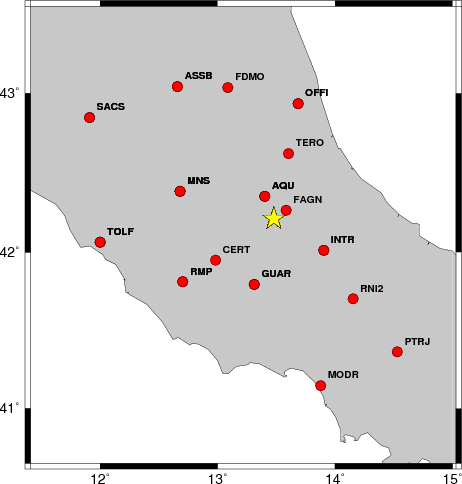
The focal mechanism was determined using broadband seismic waveforms. The location of the event and the and stations used for the waveform inversion are shown in the next figure.
|
|
|
|
The program wvfgrd96 was used with good traces observed at short distance to determine the focal mechanism, depth and seismic moment. This technique requires a high quality signal and well determined velocity model for the Green functions. To the extent that these are the quality data, this type of mechanism should be preferred over the radiation pattern technique which requires the separate step of defining the pressure and tension quadrants and the correct strike.
The observed and predicted traces are filtered using the following gsac commands:
hp c 0.02 n 3
lp c 0.10 n 3
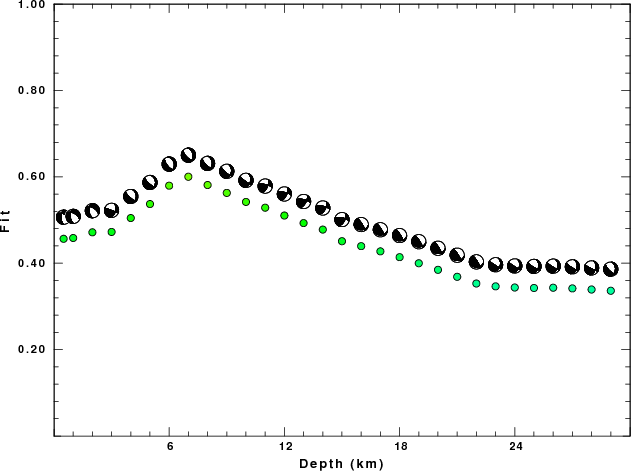
The results of this grid search from 0.5 to 19 km depth are as follow:
           DEPTH  STK   DIP  RAKE   MW    FIT
WVFGRD96    0.5   180    60   -45   3.01 0.4566
WVFGRD96    1.0   175    55   -50   3.03 0.4584
WVFGRD96    2.0   175    50   -50   3.09 0.4716
WVFGRD96    3.0    20    40     0   3.07 0.4724
WVFGRD96    4.0     5    25   -40   3.10 0.5046
WVFGRD96    5.0     0    25   -45   3.20 0.5370
WVFGRD96    6.0   345    30   -70   3.26 0.5795
WVFGRD96    7.0   350    35   -60   3.30 0.6002
WVFGRD96    8.0   360    35   -50   3.26 0.5811
WVFGRD96    9.0    10    35   -35   3.26 0.5628
WVFGRD96   10.0    15    35   -25   3.26 0.5419
WVFGRD96   11.0    25    60    25   3.25 0.5286
WVFGRD96   12.0    25    60    25   3.27 0.5104
WVFGRD96   13.0    30    60    30   3.28 0.4929
WVFGRD96   14.0    30    55    30   3.29 0.4779
WVFGRD96   15.0    30    55    30   3.31 0.4510
WVFGRD96   16.0    90    25    35   3.34 0.4395
WVFGRD96   17.0    90    25    35   3.35 0.4275
WVFGRD96   18.0    90    25    35   3.36 0.4140
WVFGRD96   19.0    90    25    35   3.37 0.3999
WVFGRD96   20.0    90    25    35   3.38 0.3847
WVFGRD96   21.0    90    25    35   3.39 0.3686
WVFGRD96   22.0    90    25    35   3.40 0.3531
WVFGRD96   23.0    20    35   -15   3.38 0.3465
WVFGRD96   24.0    20    35   -15   3.39 0.3438
WVFGRD96   25.0    15    35   -20   3.40 0.3427
WVFGRD96   26.0    15    35   -20   3.40 0.3433
WVFGRD96   27.0    15    35   -20   3.41 0.3417
WVFGRD96   28.0    15    40   -15   3.41 0.3392
WVFGRD96   29.0     5    35   -45   3.42 0.3363
The best solution is
WVFGRD96 7.0 350 35 -60 3.30 0.6002
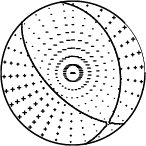
The mechanism correspond to the best fit is
|
|
|
The best fit as a function of depth is given in the following figure:
|
|
|
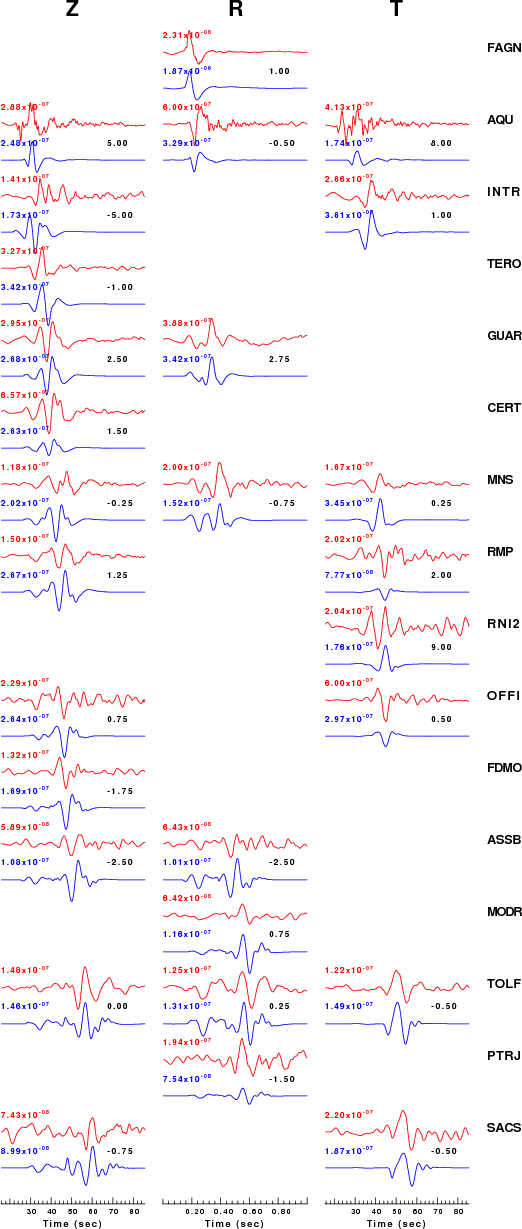
The comparison of the observed and predicted waveforms is given in the next figure. The red traces are the observed and the blue are the predicted. Each observed-predicted component is plotted to the same scale and peak amplitudes are indicated by the numbers to the left of each trace. The number in black at the rightr of each predicted traces it the time shift required for maximum correlation between the observed and predicted traces. This time shift is required because the synthetics are not computed at exactly the same distance as the observed and because the velocity model used in the predictions may not be perfect. A positive time shift indicates that the prediction is too fast and should be delayed to match the observed trace (shift to the right in this figure). A negative value indicates that the prediction is too slow. The bandpass filter used in the processing and for the display was
hp c 0.02 n 3
lp c 0.10 n 3
|
|
|
|
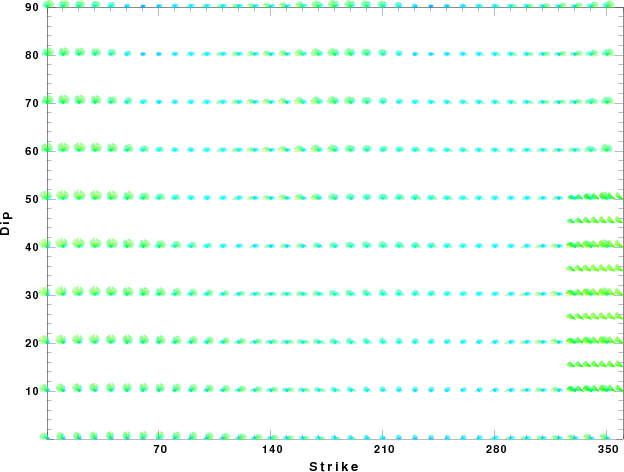
| Focal mechanism sensitivity at the preferred depth. The red color indicates a very good fit to thewavefroms. Each solution is plotted as a vector at a given value of strike and dip with the angle of the vector representing the rake angle, measured, with respect to the upward vertical (N) in the figure. |
The nnCIA used for the waveform synthetic seismograms and for the surface wave eigenfunctions and dispersion is as follows:
MODEL.01
C.It. A. Di Luzio et al Earth Plan Lettrs 280 (2009) 1-12 Fig 5. 7-8 MODEL/SURF3
ISOTROPIC
KGS
FLAT EARTH
1-D
CONSTANT VELOCITY
LINE08
LINE09
LINE10
LINE11
      H(KM)   VP(KM/S)   VS(KM/S) RHO(GM/CC)         QP         QS       ETAP       ETAS      FREFP      FREFS
     1.5000     3.7497     2.1436     2.2753  0.500E-02  0.100E-01   0.00       0.00       1.00       1.00
     3.0000     4.9399     2.8210     2.4858  0.500E-02  0.100E-01   0.00       0.00       1.00       1.00
     3.0000     6.0129     3.4336     2.7058  0.500E-02  0.100E-01   0.00       0.00       1.00       1.00
     7.0000     5.5516     3.1475     2.6093  0.167E-02  0.333E-02   0.00       0.00       1.00       1.00
    15.0000     5.8805     3.3583     2.6770  0.167E-02  0.333E-02   0.00       0.00       1.00       1.00
     6.0000     7.1059     4.0081     3.0002  0.167E-02  0.333E-02   0.00       0.00       1.00       1.00
     8.0000     7.1000     3.9864     3.0120  0.167E-02  0.333E-02   0.00       0.00       1.00       1.00
     0.0000     7.9000     4.4036     3.2760  0.167E-02  0.333E-02   0.00       0.00       1.00       1.00
Here we tabulate the reasons for not using certain digital data sets
The following stations did not have a valid response files:
DATE=Fri May 1 11:40:33 CDT 2009