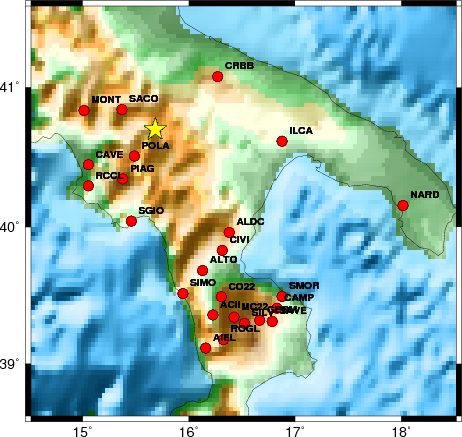
2004/09/03 00:04:12 15.68N 40.70E 5 4.0 Italy
USGS Felt map for this earthquake
USGS Felt reports page for Italy
 SLU Moment Tensor Solution
 2004/09/03 00:04:12 15.68N 40.70E 5 4.0 Italy

 Best Fitting Double Couple
    Mo = 4.79e+22 dyne-cm
    Mw = 4.42
    Z  = 10 km
     Plane   Strike  Dip  Rake
      NP1      190    85    45
      NP2       95    45   173
 Principal Axes:
   Axis    Value   Plunge  Azimuth
     T   4.79e+22     34      63
     N   0.00e+00     45     195
     P  -4.79e+22     26     314


 Moment Tensor: (dyne-cm)
    Component  Value
       Mxx    -1.17e+22
       Mxy     3.27e+22
       Mxz    -2.88e+21
       Myy     5.83e+21
       Myz     3.33e+22
       Mzz     5.88e+21


                     ----------####
                 --------------########
              ----------------############
             -----------------#############
           ----   -----------################
          ----- P -----------#################
         ------   ----------###########   #####
        --------------------########### T ######
        --------------------###########   ######
       --------------------######################
       #-------------------######################
       ##------------------######################
       ###----------------######################-
        ####--------------#####################-
        ######------------##################----
         ########--------#################-----
          ############---############---------
           ##############--------------------
             ############------------------
              ###########-----------------
                 #######---------------
                     ###-----------


 Harvard Convention
 Moment Tensor:
      R          T          F
  5.88e+21  -2.88e+21  -3.33e+22
 -2.88e+21  -1.17e+22  -3.27e+22
 -3.33e+22  -3.27e+22   5.83e+21


Details of the solution is found at

http://www.eas.slu.edu/Earthquake_Center/MECH.NA/20040903000412/index.html
|
      STK = 190
      DIP = 85
     RAKE = 45
       MW = 4.42
       HS = 10
The focal mechanism was determined using broadband seismic waveforms. The location of the event and the and stations used for the waveform inversion are shown in the next figure.
|
|
|
|
The program wvfgrd96 was used with good traces observed at short distance to determine the focal mechanism, depth and seismic moment. This technique requires a high quality signal and well determined velocity model for the Green functions. To the extent that these are the quality data, this type of mechanism should be preferred over the radiation pattern technique which requires the separate step of defining the pressure and tension quadrants and the correct strike.
The observed and predicted traces are filtered using the following gsac commands:
hp c 0.02 n 3
lp c 0.10 n 3
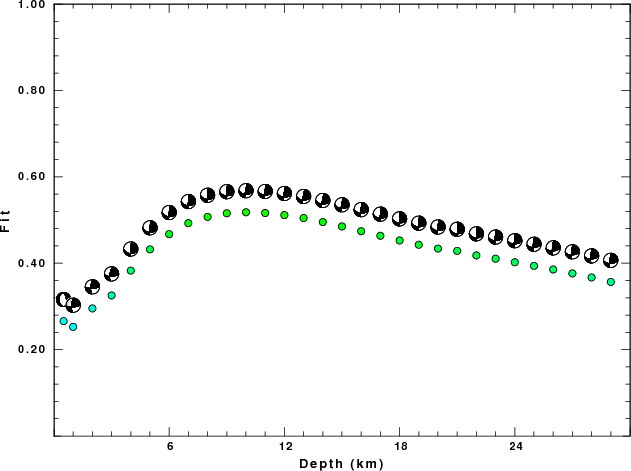
The results of this grid search from 0.5 to 19 km depth are as follow:
           DEPTH  STK   DIP  RAKE   MW    FIT
WVFGRD96    0.5   180    35   -85   4.03 0.2660
WVFGRD96    1.0   185    70    25   4.00 0.2528
WVFGRD96    2.0   185    70    20   4.11 0.2954
WVFGRD96    3.0   190    70    35   4.19 0.3254
WVFGRD96    4.0   185    90    55   4.26 0.3829
WVFGRD96    5.0   185    90    55   4.29 0.4320
WVFGRD96    6.0     5    90   -50   4.32 0.4673
WVFGRD96    7.0   185    90    50   4.34 0.4927
WVFGRD96    8.0   185    90    50   4.39 0.5073
WVFGRD96    9.0     5    90   -50   4.40 0.5156
WVFGRD96   10.0   190    85    45   4.42 0.5179
WVFGRD96   11.0   190    85    45   4.43 0.5162
WVFGRD96   12.0   190    85    45   4.44 0.5115
WVFGRD96   13.0   190    85    45   4.45 0.5046
WVFGRD96   14.0   190    85    45   4.45 0.4953
WVFGRD96   15.0   190    85    45   4.46 0.4852
WVFGRD96   16.0   190    85    45   4.46 0.4741
WVFGRD96   17.0     5    90   -50   4.47 0.4636
WVFGRD96   18.0   185    90    50   4.47 0.4527
WVFGRD96   19.0   185    90    45   4.48 0.4428
WVFGRD96   20.0   185    90    45   4.48 0.4339
WVFGRD96   21.0     0    85   -55   4.53 0.4286
WVFGRD96   22.0     0    85   -50   4.54 0.4181
WVFGRD96   23.0     5    95   -45   4.54 0.4105
WVFGRD96   24.0   185    85    40   4.55 0.4022
WVFGRD96   25.0   185    80    40   4.55 0.3939
WVFGRD96   26.0   185    80    40   4.56 0.3856
WVFGRD96   27.0   185    80    40   4.56 0.3764
WVFGRD96   28.0   185    80    40   4.57 0.3670
WVFGRD96   29.0   190    75    40   4.56 0.3567
The best solution is
WVFGRD96 10.0 190 85 45 4.42 0.5179
The mechanism correspond to the best fit is
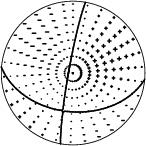
|
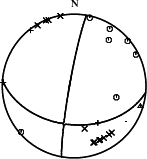
|
|
|
The best fit as a function of depth is given in the following figure:
|
|
|
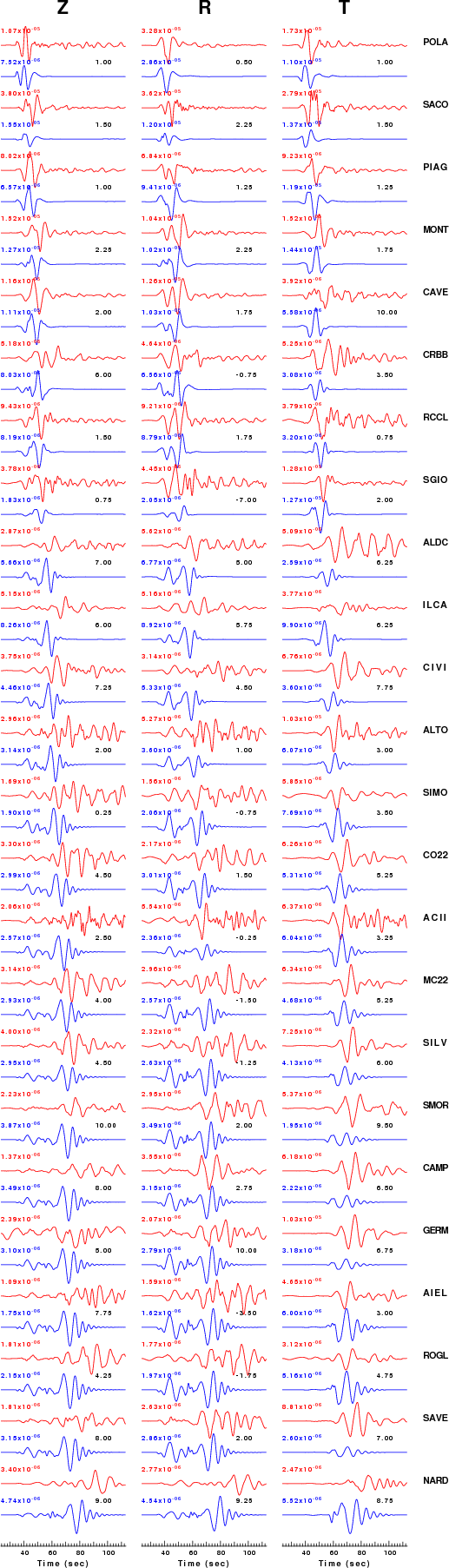
The comparison of the observed and predicted waveforms is given in the next figure. The red traces are the observed and the blue are the predicted. Each observed-predicted componnet is plotted to the same scale and peak amplitudes are indicated by the numbers to the left of each trace. The number in black at the rightr of each predicted traces it the time shift required for maximum correlation between the observed and predicted traces. This time shift is required because the synthetics are not computed at exactly the same distance as the observed and because the velocity model used in the predictions may not be perfect. A positive time shift indicates that the prediction is too fast and should be delayed to match the observed trace (shift to the right in this figure). A negative value indicates that the prediction is too slow. The bandpass filter used in the processing and for the display was
hp c 0.02 n 3
lp c 0.10 n 3
|
|
|
|
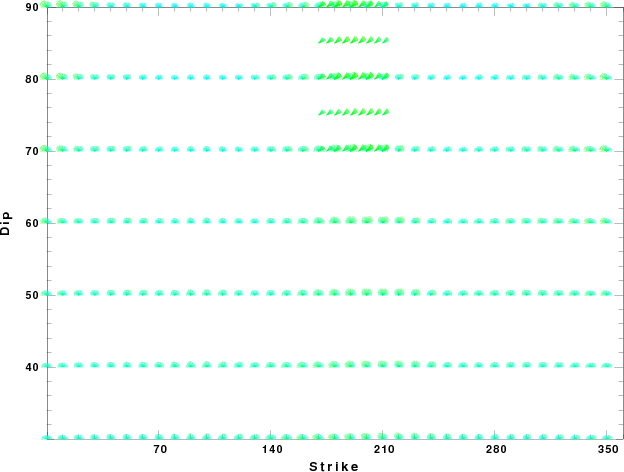
| Focal mechanism sensitivity at the preferred depth. The red color indicates a very good fit to thewavefroms. Each solution is plotted as a vector at a given value of strike and dip with the angle of the vector representing the rake angle, measured, with respect to the upward vertical (N) in the figure. |
The following figure shows the stations used in the grid search for the best focal mechanism to fit the surface-wave spectral amplitudes of the Love and Rayleigh waves.

|
|
|
The surface-wave determined focal mechanism is shown here.
 |
The P-wave first motion data for focal mechanism studies are as follow:
Sta Az(deg)    Dist(km)   First motion
PICE      189    8 iP_D
SX17       74   14 iP_C
POLA      218   27 iP_C
SACO      301   31 eP_-
VENO       22   32 iP_C
TRIC      104   37 iP_C
PIAG      214   47 iP_C
MONT      285   59 iP_D
CAVE      243   60 iP_C
CRBB       50   65 iP_C
RCCL      230   70 iP_C
CRAC      119   73 iP_C
SGIO      195   76 iP_C
ALDC      144  101 eP_+
ILCA       95  101 eP_+
CIVI      151  111 eP_X
ALTO      161  119 eP_X
SIMO      170  134 eP_X
CO22      158  144 eP_X
ACII      163  156 eP_X
MC22      157  164 eP_X
SMOR      142  168 eP_X
SILV      155  172 eP_X
CAMP      145  174 eP_X
GERM      151  175 eP_X
ROGL      162  178 eP_X
AIEL      167  181 eP_X
SAVE      148  181 eP_+
NARD      106  207 iP_C
Surface wave analysis was performed using codes from Computer Programs in Seismology, specifically the multiple filter analysis program do_mft and the surface-wave radiation pattern search program srfgrd96.
The velocity model used for the search is a modified Utah model .
Digital data were collected, instrument response removed and traces converted
to Z, R an T components. Multiple filter analysis was applied to the Z and T traces to obtain the Rayleigh- and Love-wave spectral amplitudes, respectively.
These were input to the search program which examined all depths between 1 and 25 km
and all possible mechanisms.

|
|
|

|
| Pressure-tension axis trends. Since the surface-wave spectra search does not distinguish between P and T axes and since there is a 180 ambiguity in strike, all possible P and T axes are plotted. First motion data and waveforms will be used to select the preferred mechanism. The purpose of this plot is to provide an idea of the possible range of solutions. The P and T-axes for all mechanisms with goodness of fit greater than 0.9 FITMAX (above) are plotted here. |

|
| Focal mechanism sensitivity at the preferred depth. The red color indicates a very good fit to the Love and Rayleigh wave radiation patterns. Each solution is plotted as a vector at a given value of strike and dip with the angle of the vector representing the rake angle, measured, with respect to the upward vertical (N) in the figure. Because of the symmetry of the spectral amplitude rediation patterns, only strikes from 0-180 degrees are sampled. |
Sta Az(deg) Dist(km)
Since the analysis of the surface-wave radiation patterns uses only spectral amplitudes and because the surfave-wave radiation patterns have a 180 degree symmetry, each surface-wave solution consists of four possible focal mechanisms corresponding to the interchange of the P- and T-axes and a roation of the mechanism by 180 degrees. To select one mechanism, P-wave first motion can be used. This was not possible in this case because all the P-wave first motions were emergent ( a feature of the P-wave wave takeoff angle, the station location and the mechanism). The other way to select among the mechanisms is to compute forward synthetics and compare the observed and predicted waveforms.
The velocity model used for the waveform fit is a modified Utah model .
The fits to the waveforms with the given mechanism are show below:

|
This figure shows the fit to the three components of motion (Z - vertical, R-radial and T - transverse). For each station and component, the observed traces is shown in red and the model predicted trace in blue. The traces represent filtered ground velocity in units of meters/sec (the peak value is printed adjacent to each trace; each pair of traces to plotted to the same scale to emphasize the difference in levels). Both synthetic and observed traces have been filtered using the SAC commands:

|

|
Should the national backbone of the USGS Advanced National Seismic System (ANSS) be implemented with an interstation separation of 300 km, it is very likely that an earthquake such as this would have been recorded at distances on the order of 100-200 km. This means that the closest station would have information on source depth and mechanism that was lacking here.
Dr. Harley Benz, USGS, provided the USGS USNSN digital data. The digital data used in this study were provided by Natural Resources Canada through their AUTODRM site http://www.seismo.nrcan.gc.ca/nwfa/autodrm/autodrm_req_e.php, and IRIS using their BUD interface
The figures below show the observed spectral amplitudes (units of cm-sec) at each station and the
theoretical predictions as a function of period for the mechanism given above. The modified Utah model earth model
was used to define the Green's functions. For each station, the Love and Rayleigh wave spectrail amplitudes are plotted with the same scaling so that one can get a sense fo the effects of the effects of the focal mechanism and depth on the excitation of each.
Here we tabulate the reasons for not using certain digital data sets
The following stations did not have a valid response files: